
Events
Youth Climate Change Project
A fully accessible creative climate & wellbeing programme for neurodivergent young people
Year
2026
Location
Birmingham, UK
Client
Role
Deliverables
Duration
8 hours
Story behind the project
A Creative Journey Through Art, Nature & Hope
It started with a simple question: what if talking about climate change didn't have to mean talking about fear?
For most young people, the climate conversation arrives already heavy - flooded with statistics, warnings, and a future that feels impossible to shape. At Alice Creative Space CIC, we wanted to try something different, especially for neurodivergent young people who are so often left out of that conversation altogether, or spoken at rather than invited in. So we asked another question instead: what if the planet's story was something young people could touch, build, and add to with their own hands - one chapter at a time?
That question became The Story of Our Planet: A Living Book - a four-week creative climate and wellbeing programme for neurodivergent young people aged 10 to 15, held at Three Trees Community Centre in Chelmsley Wood, Birmingham. Every session adds a new chapter to one giant, growing storybook, made collectively, page by page.
Chapter 1: Our Beautiful Home.
The book opens gently, with the world the children already know and love. In the first session, "Who Lives Here?", young people build textured landscapes with their hands before they ever pick up a paintbrush: sandpaper for the rough, ridged rock of mountains; soft fabric for calm river water and bubble wrap for water rushing over stones; corrugated card for cracked tree bark, cotton wool for clouds drifting across a painted sky. Each texture is matched to a real feeling in the landscape, so the world becomes something you can feel as much as see. Then it comes alive - rabbits, hedgehogs, foxes and ladybirds in the meadows; ducks, owls and squirrels in the woodland; seagulls and dolphins along the coast; robins and deer in the forest - until what began as a landscape becomes biodiversity itself, a home, a food chain, a web of neighbours all sharing one place.
Chapter 2: Climate Change and Awareness.
Only once that beautiful home is real and loved does the book turn, gently, toward what's changing. Rather than lecture, the sessions use a simple, physical image: Earth wrapped in a thin, healthy blanket of air, where sunshine comes in and heat escapes easily - and Earth wrapped in a blanket grown too thick, where the same sunshine gets trapped inside and everything slowly warms. From that image comes "colour temperature art" - reds, oranges and golds, jagged cracks and broken lines, built up in layers with palette knives and texture paste until the canvas itself feels parched and hot. In "Before & After" lift-the-flap windows, children take the very landscapes they built in Chapter 1 - a snowy forest, a river valley, a woodland, a coastline - and imagine them changed: rivers run dry, green hills crack and brown, skies turn hazy and grey. It's honest about what's happening to the world, without ever asking a ten-year-old to carry that fear alone.
Chapter 3: We Have Solutions.
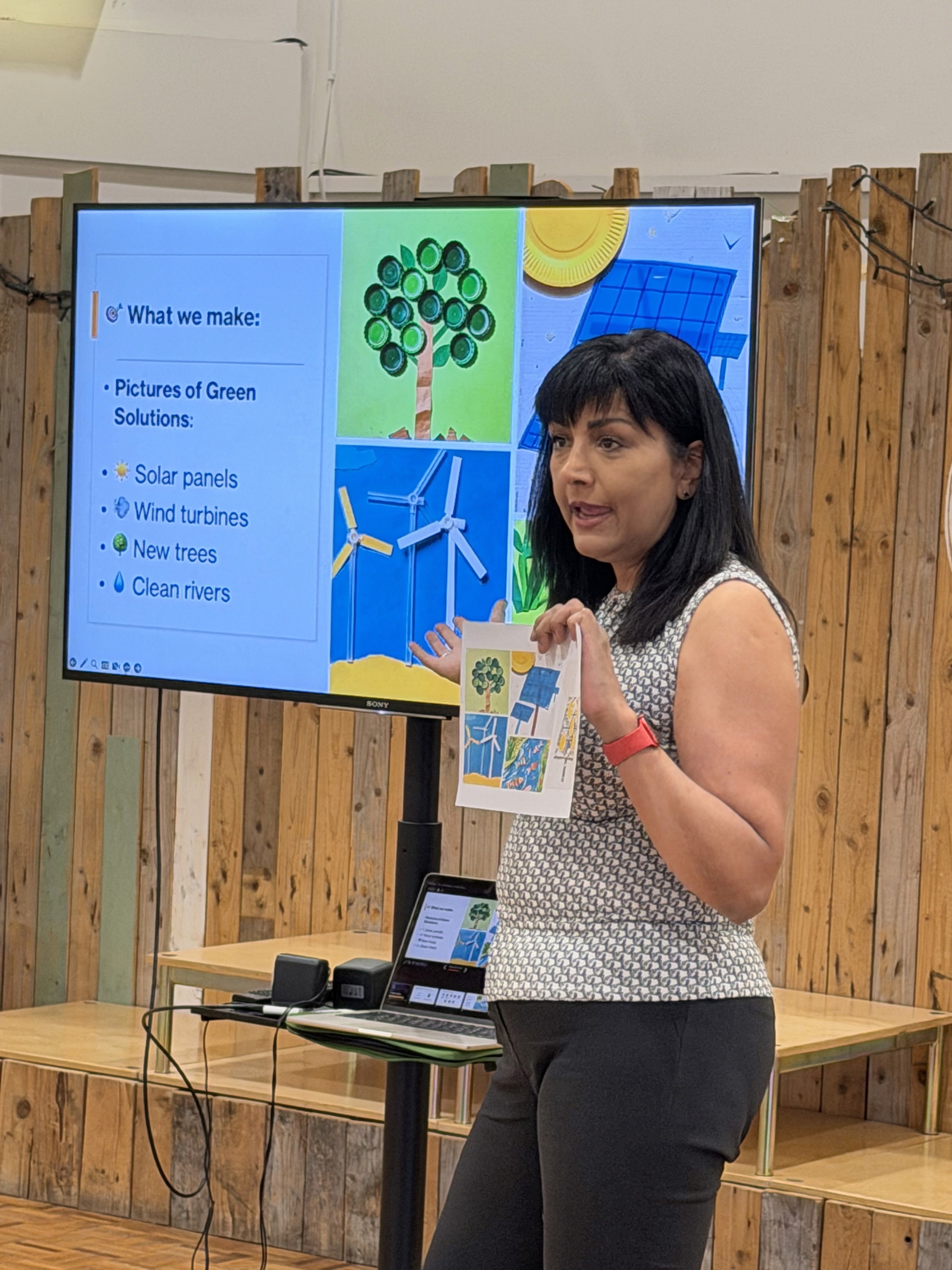
The book refuses to stop at the hard part. Chapter three turns rubbish into resources and worry into action, as children build pictures of solar panels, wind turbines, new trees and clean rivers out of reused, repurposed materials - literally constructing sustainability with their hands. Alongside them, four simple symbols take shape, drawn big and bold in bright colour: a tap for saving water, a lightbulb for saving energy, a bag for using less plastic, a sapling for growing something new. Small enough for anyone to remember, big enough to matter.
Chapter 4: Hope, Action & Celebration.
The final chapter is where the whole book comes together - everything the children have noticed, felt and imagined, gathered into one shared celebration of what they've made and what they now know they can do.
None of this depends on getting the "right" words. Every activity is built to be joined through paint, texture, gesture, eye gaze, a pointed finger, a visual choice board, or a hand guided gently through a brushstroke - because a story about ourplanet only means something if everyone actually gets to help tell it. Leading the sessions is Surinder Panesar, a certified teacher with more than 30 years in mainstream and special education, whose patient, attentive way of teaching turns each week into less of an art class and more of a shared act of trust.
What comes out of those four weeks isn't a tidy, finished answer to climate change. It's something more honest: a living book, full of fingerprints and textures and colour, that moves from wonder to worry to action to hope - because that's the true shape of the story, and these young people deserve to help write every page of it.
Albums
More work
A Creative Journey Through Art, Nature & Hope

Hands-on creative workshops for children…

Art therapy and creative wellbeing…

A Creative Journey Through Art, Nature & Hope

Hands-on creative workshops for children…

Art therapy and creative wellbeing…

A Creative Journey Through Art, Nature & Hope

Hands-on creative workshops for children…

Art therapy and creative wellbeing…

A Creative Journey Through Art, Nature & Hope

Hands-on creative workshops for children…

Art therapy and creative wellbeing…
A Creative Journey Through Art, Nature & Hope
Hands-on creative workshops for children…
Art therapy and creative wellbeing…

A Creative Journey Through Art, Nature & Hope

Hands-on creative workshops for children…

Art therapy and creative wellbeing…

A Creative Journey Through Art, Nature & Hope

Hands-on creative workshops for children…

Art therapy and creative wellbeing…

A Creative Journey Through Art, Nature & Hope

Hands-on creative workshops for children…

Art therapy and creative wellbeing…